

Dickensian Dinosaurs (why the hell is there a megalosaurus in BLEAK HOUSE???) 🦖
Notes on Scenes
Hello, fellow ghost reader!
Welcome back to my Substack!
Today we’re looking at a scene that sent me head over heels for Dickens. I’ve always loved A Christmas Carol and Great Expectations, but I came to both of them way before I was old enough to appreciate his writing technique, and, while I loved these two texts, none of his other works really appealed to me enough to read much else until I found Bleak House on my Master’s syllabus. Now, armed with four years of experience in academic analysis, and about fifteen years more life experience, Dickens was suddenly a whole new writer to me.
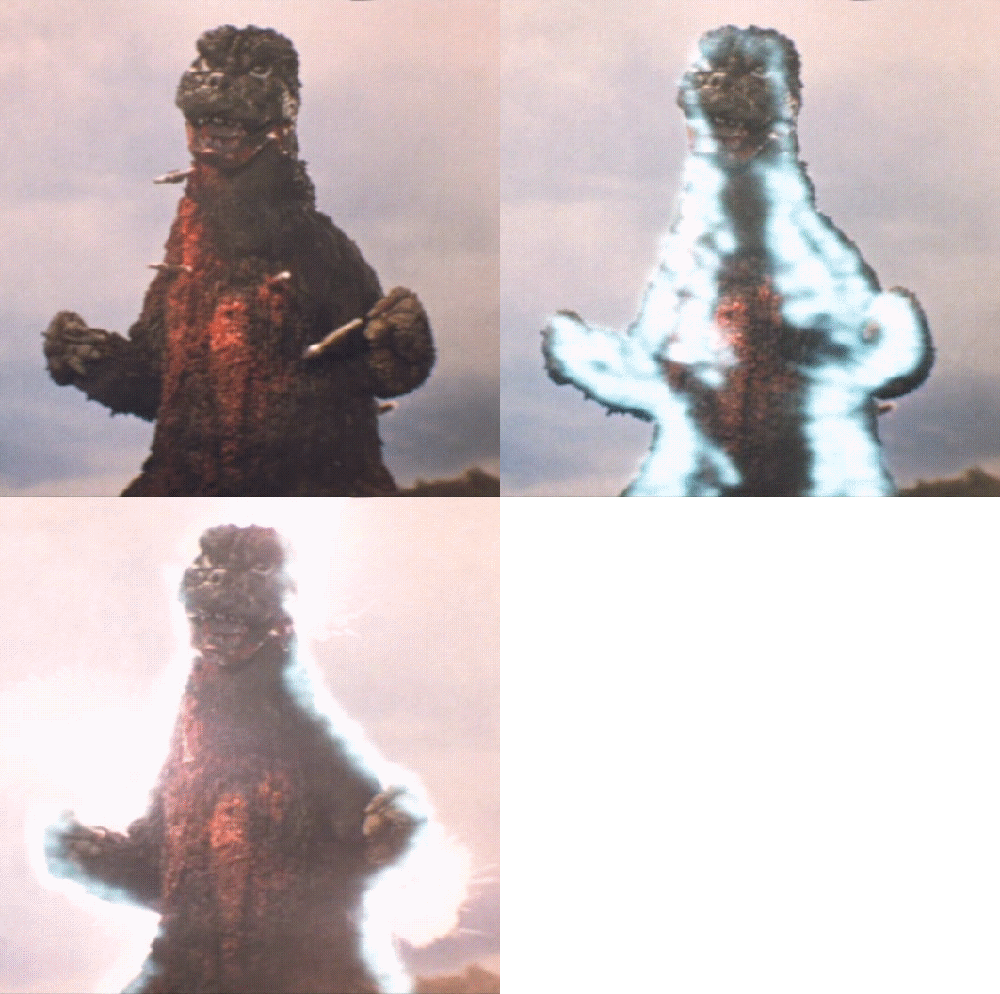
It’s another opening scene, and a surprising one, even for those intimately familiar readers of the Dickensian canon. If you know, you know. Yes, it’s the DINOSAUR SCENE! (please appreciate all my sick Godzilla gifs) 🦖
I’d hate to spoil it any more for those who haven’t come across it in all its glory, so let’s get right to it!
A ghost reader 👻
London. Michaelmas term lately over, and the Lord Chancellor sitting in Lincoln’s Inn Hall. Implacable November weather. As much mud in the streets as if the waters had but newly retired from the face of the earth, and it would not be wonderful to meet a Megalosaurus, forty feet long or so, waddling like an elephantine lizard up Holborn Hill.
(Bleak House, ch. 1)
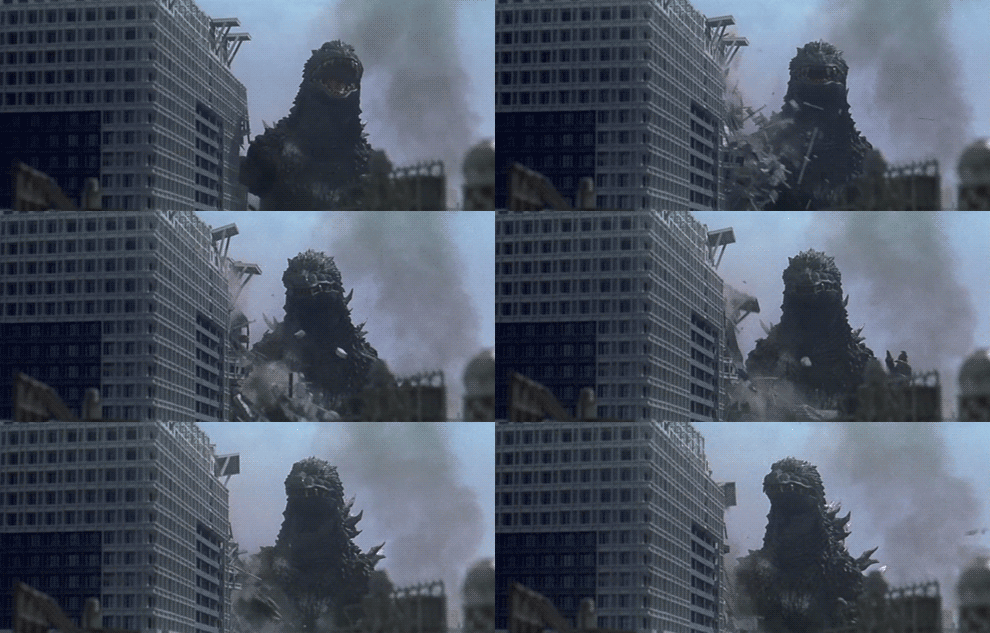
Genuinely, this is the opening to Bleak House. Fuckin WILD. So incongruous!
… Or is it?
For the record, I encountered this text in the context of an animal theory class, so I was already looking for weird animal talking points (animal points because of the class, weird because… me). Dickens liked his literary animals, and in particular Bleak House is filled with birds, dogs, horses, parasites; you name it, it’s in there. There’s a whole lot you could say about all of these, but once I saw that dinosaur I really didn’t care about any of them. Seriously, this was probably the most excited I’ve ever been about an animal in any text ever (aside from, of course, Salem the cat in Sabrina the Teenage Witch and like all goats).
But like… Charles? You okay?? This isn’t exactly vibing with the Dickensian aesthetic…
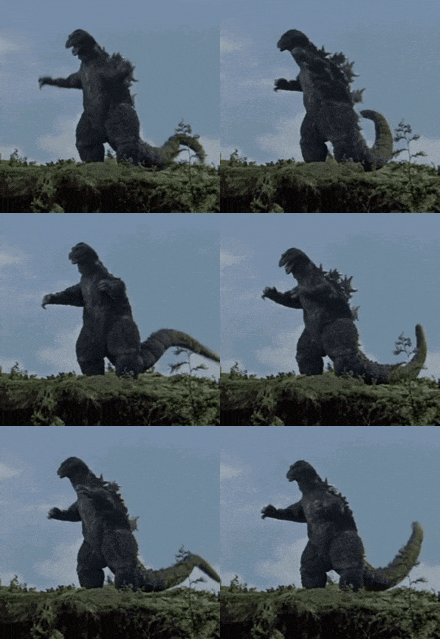
Obviously, it’s not a REAL dinosaur (tragically); it’s a ~metaphor~ for bad weather (so tragic). He’s saying that the rain is making London more suitable for prehistoric lizards than Victorian society *the lizard within me stirs*. But, even for a metaphor, it’s distinctly out of place. Even more so when you consider that this is the opening paragraph - this is how Dickens wanted to open his story, this is the scene he wanted to set upon which his legal-family-psychodrama would unfold.
The metaphorical megalosaurus never reappears. It’s image is fleeting and potentially even forgettable when it’s purpose seems so intangible compared with, say, the famous Bleak House birds about which much academic thought has been dedicated. I, however - as a lizard myself, dedicated to promoting the representation of all reptilian bodies, and determined to unravel the secrets of the Bleak House megalosaurus - could not find a single attempt to explain Dickens’ dinosaur in the entire expanse of the Bodleian online library that wasn’t entirely confined to new-historicism.
I realised I was faced with the horrifying reality that, if I wanted answers, I was going to have to analyse the text myself. Gasp! The situation seemed grave, but the thought of coming into class with an answer to this 172-year-old question was appealing enough to my ego that I gave it a go. This is what I came up with:
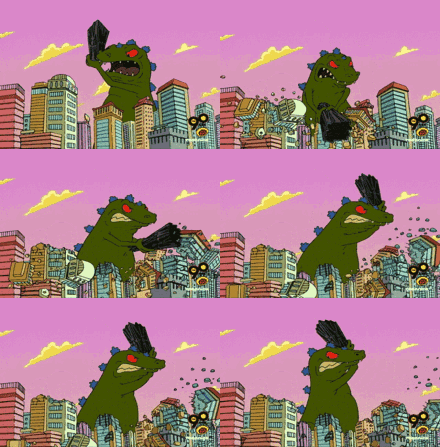
One of the more obvious themes of the novel is motherhood. Obviously, this is a theme directly impressed by the action of the text as heroine Esther Summerson uncovers her long-lost ancestry after meeting her unfortunate mother Lady Deadlock. But the theme of maternal identity is more complex than the Jeremy Kyle-style reveal. In Bleak House, there is a constant uncertainty around motherhood as children are moved around and redistributed amongst female care as their natural mothers reject the role (Mrs Jellyby, for example), or are dispossessed of it (Lady Deadlock), allowing new mothers to form (Esther, herself, becomes the idealised mother when she effectively fosters Charley and her two siblings). The mother is able to change shape, reanimate, she is forced into being sometimes without having given birth, the act of which becomes disconnected from the conceptualised mother of the novel.
In this way, we might think of the tenuous point of contact between the act of birth and the figure of the mother in terms of a kind of uncanny site of genesis which perpetuates itself throughout the space of the narrative. The megalosaurus, then, waddling out of the mud takes on this primordial quality, not just in that it is a literal dinosaur, but in that it appears fully formed without physicality, and disappears into total non-being. Dickens draws on the hot, new theory of Darwinian evolution into his literary London as bodies and identities are animated by their environment at random without the need for strict ancestral or temporal hierarchies. His dinosaur then represents the pinnacle of this ‘uncanny genesis’ as an inexplicable body, at once impossible, and totally at home in its environment.
Bleak House is a text deeply concerned with the spontaneity of natural form - this ‘uncanny genesis’ arguably has it’s counterpart in the inexplicable spontaneous combustion of Mr Krook. The natural bodies of Bleak House are not just ephemeral, but also deeply, dangerously unstable, capable of animating, transforming or exploding at random. Anna Henchman, in her brilliant essay ‘Tallow Candles and Meaty Air in Bleak House' (2017) argues that the grisly fate of Mr Krook is just one example of the novel’s dialectic between the live and the dead body. (Another example would be the setting of the meat market where commerce and consumerism manifest in the selling of both livestock and meat.) Reminiscent of the animal body, whose value, which fluctuates for the individual consumer, is based on pedigree or the service it might perform just as much as its cut or fat content, the natural bodies of the novel take on the grotesque tactility of meat as they are continuously rendered, stratified and (re)categorised in terms of their social role and their mortal status. In Bleak House death is not a slow decline, it happens suddenly and randomly, and rarely is the direct cause of the tragedy experienced by the other characters. The space of the novel randomly implodes and explodes natural life, at once animating and casting into extinction.
In this light, the opening chapter proves to be a structural depiction of Bleak House world-building. A dinosaur appears on the streets in a way which is both out of place and entirely appropriate for the miserable environment. And just as soon as it arrives, it vanishes so quickly the reader doesn’t even know what to do with it. We’re supposed to be confused by it, and even overlook it, comforted when Dickens settles us into the dreary rhythms of unintelligible legal paperwork, leaving only the Lord Chancellor and the endless business of Jarndyce and Jarndyce.
For Dickens, mud is spontaneous and unpredictable; society cannot rely on nature, and so must cling to the depressingly reliable processes of English bureaucracy. Rather than a dynamic engagement with Victorian identity politics that the rest of the novel explores, Jarndyce and Jarndyce collapses passionate family intensity into the laboured ministering of complex inheritance law. Indeed, the comforting consistency of Jarndyce and Jarndyce is arguably the closest we get to a sense of eternity - the details of which are as mysterious as God Himself, and which passes by generations of its advocates without issue, resolution or new understanding. Time is warped around Jarndyce and Jarndyce as all natural history - from the dinosaurs to the society of Victorian London - pass by the window of the man overseeing the case. When presented alongside the comparatively fleeting megalosaurus, the case is presented in almost evolutionary terms as the dinosaur spontaneously animates within the imagery of the novel, existing for only a fraction of the lifespan of the case. It’s like a bad joke the Lord Chancellor tells himself: species die out, empires fall, but Jarndyce and Jarndyce remains.
(Either that, or the Lord Chancellor just wants his mum.)
this is so interesting!! although i haven't read this book (or many of the ones you write about) i still absolutely love reading your thoughts and your analysis of them - and you do it in a very accessible and understandable way, which i think i've told you before, but it is still true!! i am forever in awe at your ability to delve so deeply into just a couple of sentences. i am extremely jealous!!!
i cannot say i have ever been a big fan of dickens - i enjoyed reading a christmas carol in school but i tried to read great expectations a few years after and barely understood 1/3 of what that man was saying - but you're making me want to try again!! i've been considering it anyway, thinking maybe i was still a little too young to fully understand back then, so i'm seeing this post as a sign to pick it back up!!
This take on the dinosaur metaphor as a connection not only to the primal sludge of the weather but its alignment to the bureaucracy is really good. Would you consider a Michaelmas- Megalosaurus connection? St. Michael slew a dragon, so could the megalosaurus be dragon imagery while also aligning with the fabulous new realm of evolutionary considerations? Even though Michaelmas is a common term indicating the time of year, it was that pagan/Christian tale of the dragon that draped itself over the dinosaur when I first read the novel as a student.