

AMORET'S BLOOD an essay on gazing on female torture. III
Busirane's pov
Hello fellow ghost reader!
Welcome back to my Substack!
Today I’m publishing Part 3 of 4 of ‘Amoret’s Blood’ — an essay I wrote for my Master’s degree for a module I took on Edmund Spenser’s The Faerie Queene.
It’s an exploration into the presence and significance of blood in Book III canto xii of TFQ, where the female knight, Britomart, ventures into the house of Busirane - a wicked magician who has kidnapped Amoret and is attempting to torture her into loving him - in order to rescue Amoret and return her to her witless true love Scudamore.
So far we’ve examined the scene from Amoret’s perspective as she experiences her torture, and Scudamore’s perspective as her incapable lover. This time, we’re examining the experience of Busirane, the wizard who has captured her in a violent attempt to secure her affection.
(Here’s the link for Parts I and II, or for more Faerie Queene content you can read my mini essay on space and language in the opening stanzas here.)
Enjoy!
A ghost reader 👻
tw: this essay includes references to sexual violence and torture
Amoret’s Blood
III.
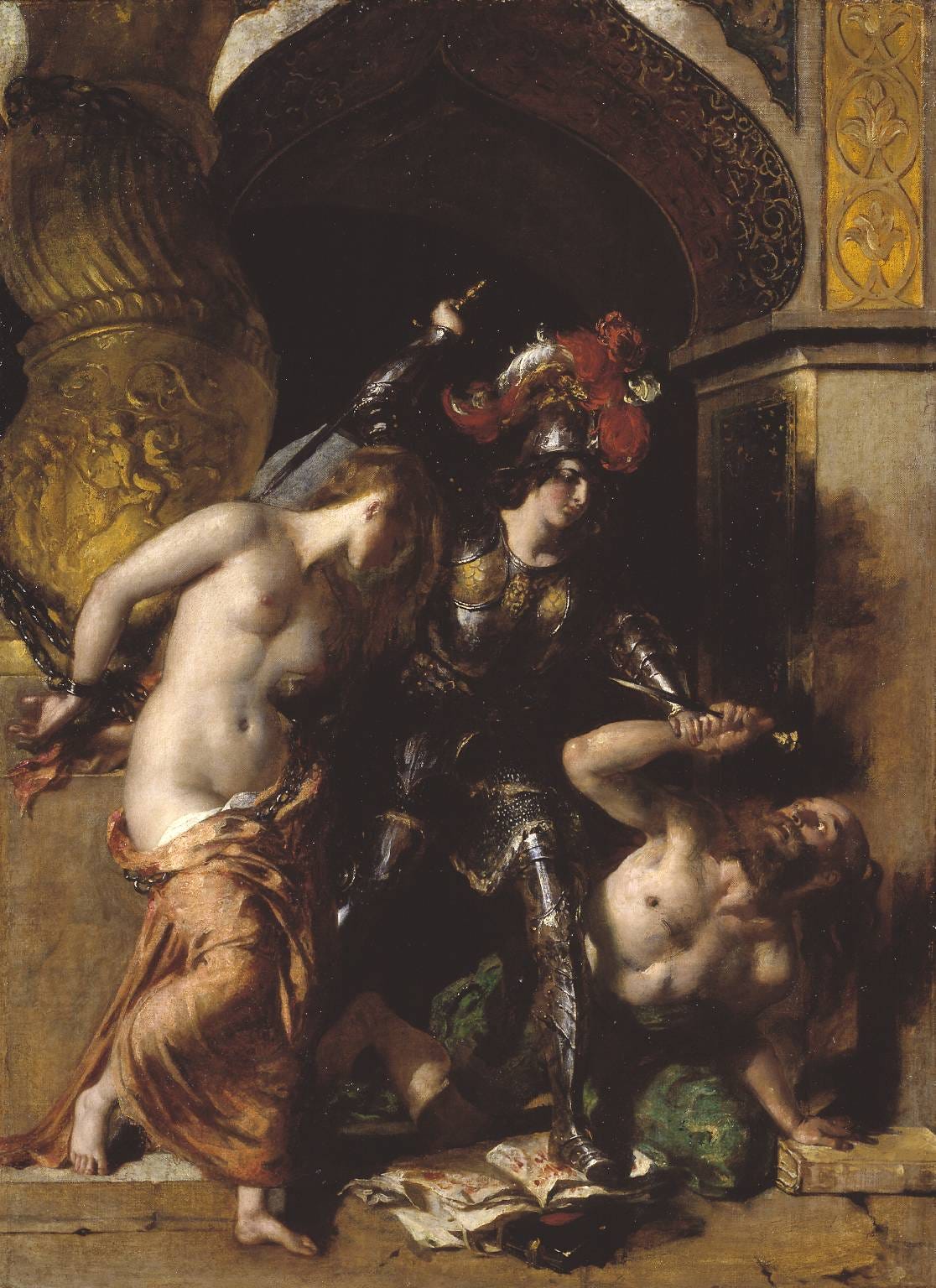
Another intriguing presence is that of her torturer, Busirane, for whom the point of contact with the mutable qualities of Amoret’s blood causes significant problems for his villainous, masculine identity.1 The sexual connotations of the torture imagery effectively function to construct a heterosexual consummation: Amoret’s body is attached to Busirane’s ‘brasen pillour’, exposing her orafice to him (III.xii.30-31). However, when Britomart entres and beholds the scene - Busirane at work attempting to move her desire by ‘Figuring straunge characters of his art, / With [Amoret’s] liuing bloud’ (III.xii.30.2-3) - it seems clear that the act of reaching into the wound to source blood as ink for his ‘charmes’ (III.xii.31.8)’ mirrors manual, rather than penetrative, sex. Such an act sees Busirane offer pleasure without physically receiving it himself. This is not to suggest that Amoret enjoys this sexual encounter, but his subsequent inability to ‘remove her ‘stedfast hart’’ (read: pleasure her) (III.xii.31.9) constructs Busirane as one who is incapable of satisfying his own desire in the female body - essentially, he finds himself unable to ‘finish’. Moreover, one can hardly fail to recognise the symbolic significance of the image of bleeding female genitalia. That menstruation is the only result of Busirane’s torturous acts reaffirms the degrading force with which Amoret’s blood confronts him, as it mocks his inability to ejaculate and potentially impregnate her. This does not preclude Frye’s assertion that this scene constructs an allegorised rape (or at least sexual assault, given he will not penetrate)2 - his inability to remove Amoret’s ‘steadfast heart’ (III.xii.31.9) might suggest that his attentions are, at best, disappointing. However, though we might think that the phallic pillar must be Busirane’s, if our interpretation holds - that he is performing manual sex on Amoret - then the depiction of an erect penis belonging to Busirane becomes defunct since he is not the one being stimulated, and we are presented with a now disembodied phallus which we must seek to understand. Thus, we must question what the phallic symbol (particularly in its erect state) is doing at this moment. Is it there simply to taunt Busirane’s impotence? Perhaps, but on returning to this stanza, an alternative emerges - one that affirms Spenser’s concern for the extended body - as we now notice that Busirane is not mentioned at all. Busirane does not bind her hands and tie her to the pillar, instead Britomart sees Amoret:
both whose hands
Were bounden fast, that did her ill become,
And her small wast girt round with yron bands,
Vnto a brasen pillour
(III.xii.31.6-9)
Although it is tempting to assume that he is the one to stage this depiction of bondage, on the page Busirane is entirely absent - removed, a metaphorical castration, from the phallus which has been subsumed into the body of his desired lady, preventing his own entrance. Here, the phallus is aligned with Amoret’s body (literally, in that she is attached to it), and in this way we might reinterpret this scene as one in which Amoret posses the yonic wound, the phallic pillar, and the excess of desire (her overflowing blood), which threaten Busirane, even as he attempts to use them for his own arts. Consequently, Busirane ‘emasculates himself by misreading his metamorphosed body; in distinguishing male from not-male, he denies physical sexuality and consigns desire to the female other’3 who at this moment possesses the bigger penis. Much like the phallus which has become disconnected from him, Busirane attempts to project desire into Amoret’s body from a safe distance in which his own manhood does not come into contact with a body who might outmatch him. Therefore, this is not, Silberman warns us, an ‘inadvertent’ self-castration, but one which is betrays self-awareness of his identity as one who cannot impose masculine will over a woman,4 forcing him to assume the female role in the heterosexual dynamic he attempts to construct. Busirane’s zealous insistence on traditional heterosexual dynamics ironically creates the potential for queer interpretation, and lends the scene both a hetero- and a homosexual consciousness. Busirane is a man violently assaulting a woman. He is also feminised by the gender-queering presence of Amoret’s own giant penis, frustrated by patriarchal oppression. And he is frustrated by the parental impossibilities of copulation with a body that mirrors his own.5 After all, it would justify the failure of his attempts to ‘finish’ through ejaculation if Busirane is, in some respect, a woman, rubbing up against another woman and expecting to make a baby.
This hermaphroditic depiction of Amoret builds on our earlier notion of her body as one which possesses both desire (which we might think of as phallic masculinity) and the means of pleasuring it (the feminine sex organ), which serves to draws to the (de)construction of the body, especially in its manifestation as a sexual experience. Spenser alludes to his own poetic art in the act of torture - ‘Figuring straunge characters of his art, / With liuing bloud he those characters wrate’ (III.xii.31.2-3) - a curious moment to metaphorically reference the creative act. Considering Spenser is unlikely to identify with Busirane, whom he knowingly introduces as ‘wicked’ (III.xi.10.7), we can assume that his intention for this self-insert was not to encourage empathy in the reader, or even to directly connect Busirane to his own identity. Instead, considering the reading we have thus far developed, we might assert simply that Spenser is drawing our attention in this moment to his active construction of the body within the text, aligning the poetic act to that of sexual procreation. This reading bolsters this essay’s preposition, which is interested in examining and deconstructing the bodily aesthetics of this scene, as we are able to assert that this is how Spenser intends to direct our focus. Only by acknowledging the connection between the poetic act and the sexual body (both of which Busirane fails in) do we realise that Busirane fails to comprehend the construction of Amoret’s body in his attempt to display Petrarchan convention.6 This supports the idea that this scene is the result of male-imagination7 to the extent that Busirane is troubled by its limitations. Busirane believes that the masculine act of creation (in both the creative and sexual sense) lies solely in the ability to generate the corporeal manifestation of the female desire, and so commits the violent act of carving the chest to resemble female genitalia, mistaking its physical form for its symbolic connotations. However, the abject nature of Amoret’s blood means that, by removing it to write out his spells, he actively affirms Amoret’s abject desire, unattached to her body or identity. Ironically, Busirane fails to look too deeply into Amoret, only comprehending her grotesque body - now exhibiting an aggressive and violent sexuality, who’s gaping vagina mocks his importance, and who’s erect phallus threatens him with the penetration of his own body. In this way, Amoret’s body confronts Busirane by casting his desire into the uncanny space of a realised physicality by transforming them into the feminine fears often assigned to Amoret.
To be continued 25th April…
As Harry Berger Jr. notes, ‘Busirane’ is made up of Busy-reign - ‘the male imagination trying busily (because unsuccessfully) to dominate and possess woman's will’; Harry Berger Jr., ‘Busirane and the War Between the Sexes: An Interpretation of "The Faerie Queene" III.xi-xii’ English Literary Renaissance, 1.2 (1971), 99-121 (p. 100) <https://www.jstor.org/stable/43446748> [accessed 2 December 2023]; see also, William Nelson, The Poetry of Edmund Spenser: A Study ((New York: Columbia University Press, 1963), pp. 229-30; Kathleen Williams, Spenser’s World of Glass: A Reading of the Faerie Queene (Berkeley: University of California Press, 1966), pp. 109-10. Connections have also been made to the tyrant Egyptian king, Busiris ‘who believed, [...] that man should ‘let the woman feel the smart of a wound she first inflicted’, and the he sixteenth-century sense of the word ‘abuse’ as ‘imposture [...]’ as well as with the obsolete form ‘abusion,’ defined as ‘deceit, deception’’; Claudia M. Champagne, ‘Wounding the Body of Woman in Book III of The Faerie Queene’ LIT, 2.2 (1990), 95-115 (p. 109) <https://doi-org.ezproxy-prd.bodleian.ox.ac.uk/10.1080/10436929008580049> [accessed 1 December 2023].
Susan Frye, ‘Of Chastity and Violence: Elizabeth I and Edmund Spenser in the House of Busirane’ Signs, 20.1 (1994), 49-78 (p. 50)<https://www.jstor.org/stable/3174927> [accessed 23 November 2023].
Lauren Silberman, ‘The Hermaphrodite and the Metamorphosis of Spenserian Allegory’ English Literary Renaissance, 17.2 (1987), 207-223 (pp. 221) <https://doi.org/10.1111/j.1475-6757.1987.tb00933.x> [accessed 30 November 2023].
Silberman, ‘The Hermaphrodite and the Metamorphosis of Spenserian Allegory’, pp. 221.
Insofar as same-sex dynamics generally cannot produce biological children. This is not to suggest Busirane is actively attempting to procreate with Amoret, just that he desires to demonstrate his masculinity by ejaculating into her.
Linda Gregson, The Reformation of the Subject: Spenser, Milton and the English Protestant Epic (Cambridge: Cambridge University Press, 1995), pp. 180-6.
Berger, ‘Busirane and the War Between the Sexes’, pp. 100.